Others give you an AI developer.
NoMoreHappyPath gives you the software company.
Product, QA, engineering, security, code audit, CTO, release, support and finance. Every department a real software company has, already hired. You are the CEO: you say go ahead, and nothing ships until you accept it.
Governance built in, not bolted on. Others govern what an AI agent can access. NoMoreHappyPath governs what it delivers: requirements you approve, tests the builder can’t change, independent review, and evidence you can read.
Free and open source (Apache 2.0) · macOS and Linux · runs on your machine, with your own AI accounts
Claude built Acremuse, a live commercial app. NoMoreHappyPath reviewed its code: 33 real problems found, against 10 by one AI alone. Narration by AI.
Built by someone who has shipped commercial software for 35 years. About the builder →
Same job, same 374,000-line app. 33 real problems against 10.
Claude built Acremuse, a live commercial app, with Codex reviewing. It was not built with NoMoreHappyPath. The owner then gave one job to a single Claude session and to NoMoreHappyPath: find what could stop it being used commercially. A judge from a different company, blind to which was which, checked every claim against the original code.
One codebase, one run each, two judging runs. A case study, not a benchmark.
Most AI says “done” in one step. This takes 26.
Spec it
You approve a plain-words contract. A reviewer from another AI company writes the tests first, and each one must fail before it counts.
Build it
The builder codes to the locked tests and runs every scenario itself. One failure and the review request is refused.
Challenge it
The reviewer runs the real product, blockers go back for repair, and you accept the work or send it back.
In plain English. Your exact words are captured, never altered.
Your request becomes numbered requirements in plain words.
A reviewer from another AI company reads them first and plans a test for each.
Only when needed: up to 4 multiple-choice questions, best answer pre-picked. Skip any time.
Or go ahead with the recommended answers.
You say Go ahead on a plain-words contract that lists what will be tested.
From the contract, before any code exists.
Each requirement has a test with a failure case. A gap goes back once, and you are never held.
Stored with a fingerprint (SHA-256). The builder cannot change them.
Run on the project before the work exists. A test that passes there proves nothing and does not count.
If a test assumes something that is not real, the builder says so once and the reviewer settles it.
A plan for every scenario. A task is split into parts only when you allow it.
To the locked tests.
Its own checks must pass before it may ask for a review.
The builder's own “pass” is not the grade. The board runs the locked tests and records the real results.
Refused while any locked test fails.
The reviewer uses the real product, in a real browser when it has a screen, and runs its own challenges.
Every blocker, with its harm and the steps to reproduce it.
The whole list at once. The tests stay read-only.
Only real problems can block now. New nitpicks become notes.
Still failing? One last try, on a stronger model if you set one. Then you choose: fix once more, take what you have, or stop.
The whole app, start to finish, the way you asked for it.
The full test suite on the combined work. The CTO release gate blocks if evidence is missing or tampered.
A copy of the app you can open and use yourself.
Accept, or Not accepted with your reason: it goes straight back into repair.
It reaches the project's main, and your GitHub if you set one.
See all 26 steps on one page
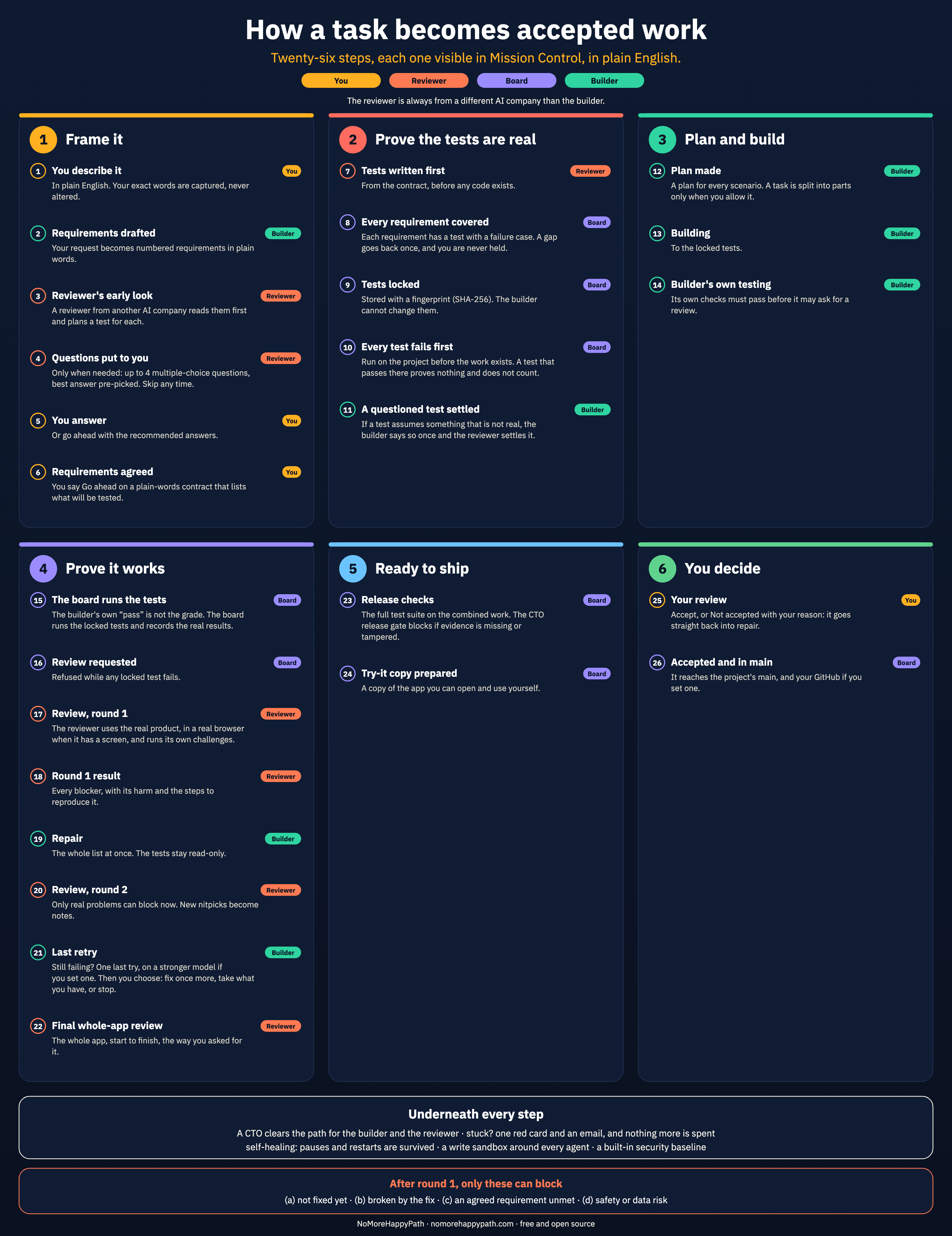
- 1. Frame it
- YouYou describe itIn plain English. Your exact words are captured, never altered.
- BuilderRequirements draftedYour request becomes numbered requirements in plain words.
- ReviewerReviewer's early lookA reviewer from another AI company reads them first and plans a test for each.
- ReviewerQuestions put to youOnly when needed: up to 4 multiple-choice questions, best answer pre-picked. Skip any time.
- YouYou answerOr go ahead with the recommended answers.
- YouRequirements agreedYou say Go ahead on a plain-words contract that lists what will be tested.
- 2. Prove the tests are real
- ReviewerTests written firstFrom the contract, before any code exists.
- BoardEvery requirement coveredEach requirement has a test with a failure case. A gap goes back once, and you are never held.
- BoardTests lockedStored with a fingerprint (SHA-256). The builder cannot change them.
- BoardEvery test fails firstRun on the project before the work exists. A test that passes there proves nothing and does not count.
- BuilderA questioned test settledIf a test assumes something that is not real, the builder says so once and the reviewer settles it.
- 3. Plan and build
- BuilderPlan madeA plan for every scenario. A task is split into parts only when you allow it.
- BuilderBuildingTo the locked tests.
- BuilderBuilder's own testingIts own checks must pass before it may ask for a review.
- 4. Prove it works
- BoardThe board runs the testsThe builder's own “pass” is not the grade. The board runs the locked tests and records the real results.
- BoardReview requestedRefused while any locked test fails.
- ReviewerReview, round 1The reviewer uses the real product, in a real browser when it has a screen, and runs its own challenges.
- ReviewerRound 1 resultEvery blocker, with its harm and the steps to reproduce it.
- BuilderRepairThe whole list at once. The tests stay read-only.
- ReviewerReview, round 2Only real problems can block now. New nitpicks become notes.
- BuilderLast retryStill failing? One last try, on a stronger model if you set one. Then you choose: fix once more, take what you have, or stop.
- ReviewerFinal whole-app reviewThe whole app, start to finish, the way you asked for it.
- 5. Ready to ship
- BoardRelease checksThe full test suite on the combined work. The CTO release gate blocks if evidence is missing or tampered.
- BoardTry-it copy preparedA copy of the app you can open and use yourself.
- 6. You decide
- YouYour reviewAccept, or Not accepted with your reason: it goes straight back into repair.
- BoardAccepted and in mainIt reaches the project's main, and your GitHub if you set one.
AI governance you can run
Rules
Agents can’t edit the board or the locked tests.
Separation of duties
The reviewer is never from the builder’s company.
Evidence
Test and review results are recorded, and anything not tested for real says so.
Oversight
A CTO watches the process.
Authority
Only you accept the work.
Everything a software company needs, on your machine
Underneath it all: a board the agents can’t edit, an operating-system sandbox around every agent, and self-healing when an agent stalls.
Mission Control
A friendly interface to talk to the agents and see where each task is, step by step, explained in plain English.
A CTO that clears the path
It doesn’t only monitor: it clears the way for the builder and the reviewer so nothing stays stuck, and never asks you a technical question.
The right model, within your quota
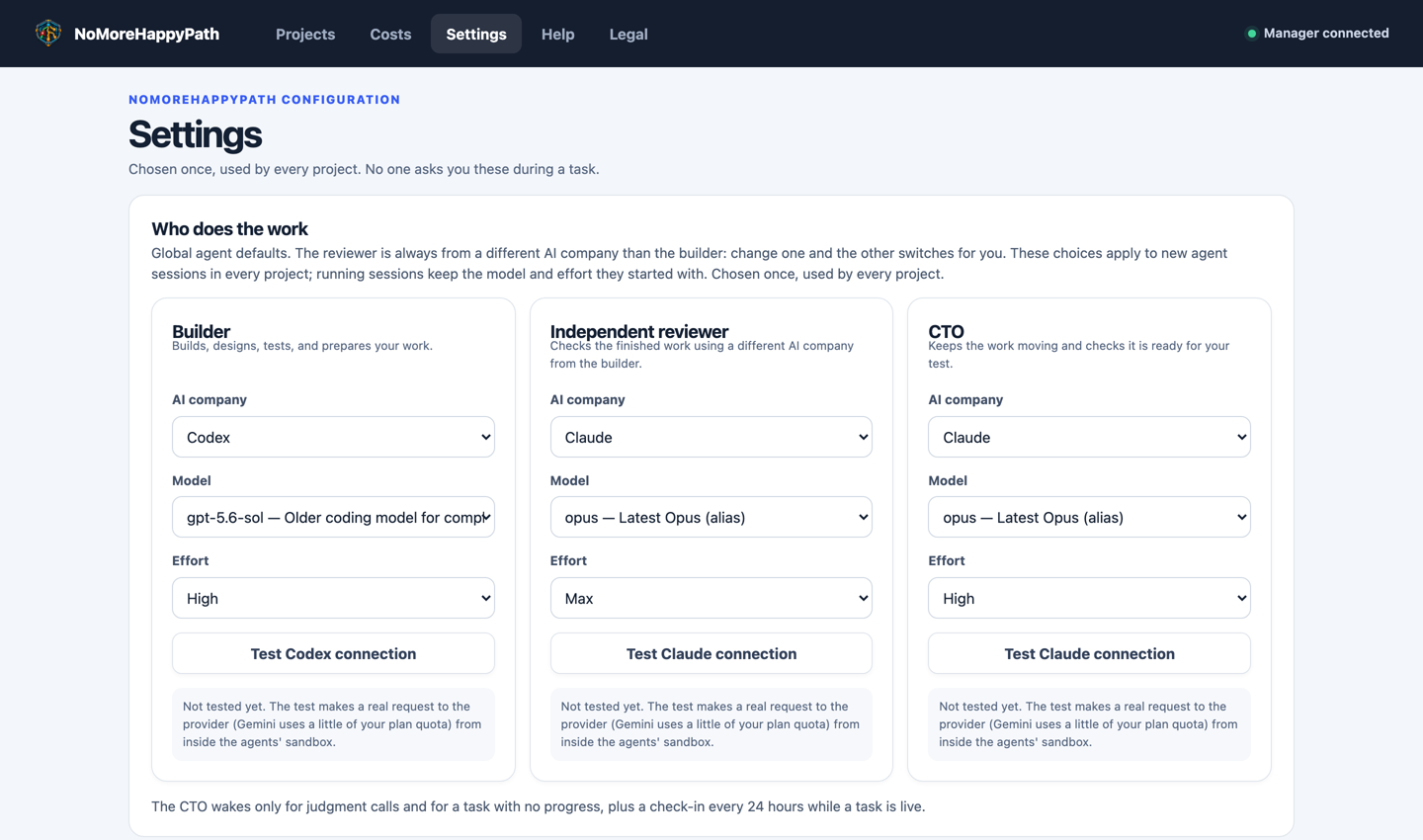
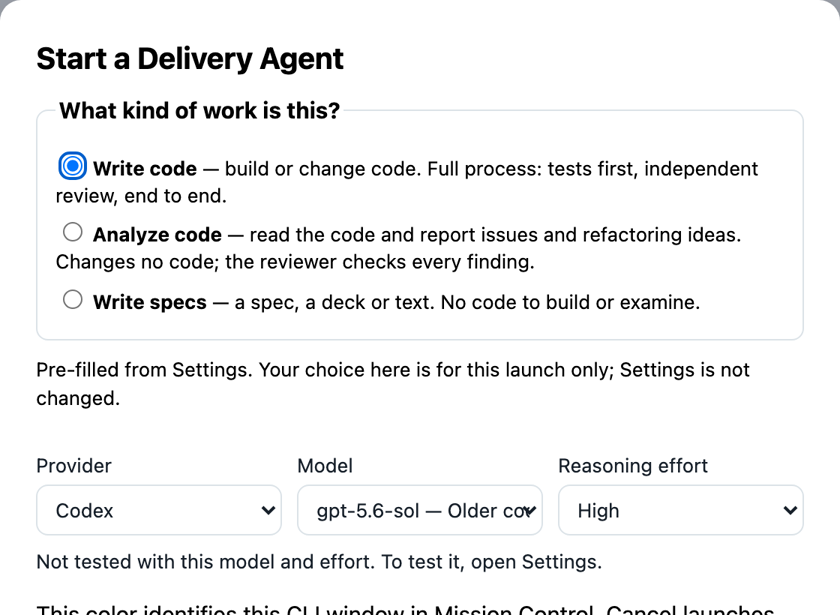
Claude, Codex or Gemini in any role. Specs on higher models, code on lower ones, an automatic switch to a higher model when needed, and a check on your quota.
Test where it will run
Define virtual machines of different operating systems as test targets. A Windows program is built and tested on a real Windows machine, from your Mac.
Ask, look back, pause
Ask questions about your project, look at its full history, and pause and restart without losing anything.
Security, enhanced on demand
Every app gets a built-in security baseline. Switch on Enhanced security for a task and it adds a threat model, security tests and a controls register, ready for a security assessment or audit.
Real products, built with it
PropDesk at work
PropDesk, built with NoMoreHappyPath: parcel, utilities, flood, zoning, traffic and more in one workspace. Narration by AI.
Studio, a marketing agency
How a complete marketing agency was built with NoMoreHappyPath, and what it does. Narration by AI.
Not for the five-minute demo.
Built for solo founders, senior engineers and domain experts who ship commercial software. The wrong tool for:
- a hackathon project that must run by Sunday
- a hobby app where being wrong costs nothing
- a build you will not pay for: a serious build runs on your own AI plans
What you need, and two commands
The platform is free. The AI agents it runs are not: they use your own accounts, and a serious build costs real money on them.
| You need | Why | Cost |
|---|---|---|
| macOS 13+ or Linux | Tested on Ubuntu 24.04. Python 3.9+. To run it, Windows isn’t supported (it can still build and test Windows programs). | Free |
| Two AI companies’ CLIs | Any two of Codex, Claude Code and Gemini (Antigravity CLI), so the reviewer is never the builder’s vendor. | Your own plans |
| OpenAI API key | Your own key, only for asking questions about your project. | Pay per use |
git clone https://github.com/nomorehappypath/nomorehappypath.git
cd nomorehappypath && bash install.sh
The installer checks everything above and tells you plainly what’s missing. Then open Mission Control, point it at a project folder, and give your first direction.
Built by someone who has shipped commercial software for 35 years
I’m Gerard Rafie. For more than 35 years I led product management, marketing and sales in fintech: I conceived, built, marketed and sold technology solutions for banks, and I advise banks and private equity firms on treasury, capital markets and AI.
I built NoMoreHappyPath because AI kept telling me “done” when it wasn’t. I use it for my own products, and so do my clients.
What people ask first
How is this different from other open-source AI dev harnesses?
Many harnesses help you run agents, and leave the quality process for you to design. NoMoreHappyPath ships the whole route by default, and it's built for a solo builder who wants to ship commercial software, not demos:
- Agreed before built. The reviewer asks you up to four multiple-choice questions, and you approve a plain-words contract before any code exists.
- Tests that are real. A reviewer from a different AI company writes the tests first; a coverage check makes sure every requirement has one; every test must fail before the work, or it doesn't count.
- A board no agent can edit. The board runs the tests itself and records the real results, so a pass can't be faked.
- Reviews that end. Three bounded rounds, then a retry on a higher model, or an honest “could not finish”. Never an endless loop.
- A control room you can understand. Mission Control shows every step in plain English, and a CTO clears the path so nothing stays stuck.
- Built for real targets. Test on virtual machines of different operating systems, pick the model for each role within your quota, and pause or restart without losing anything.
- Security built in, and enhanced on demand. A security baseline on every app, and an Enhanced security switch per task that adds a threat model, security tests and a controls register.
- You decide. Nothing is done until you review and accept it.
- Proven on real products. A land due-diligence platform, a pre-purchase analysis app and a marketing agency, each used by a client.
Isn’t AI reviewing AI just theatre?
The reviewer isn’t reading a diff and nodding. It writes its own tests, the harness runs them and keeps the output, and the verdict has to match that output. A pass with no recorded execution behind it is refused. It also has no reason to agree: it comes from a different company than the builder.
What does it cost to run?
The software is free. The agents run on your own subscriptions. A serious build uses real usage. Using a top model for the plan and lighter models for building and review keeps that down.
Why does even a small app take so long?
Because the harness builds for release, not for a demo. It agrees the requirements first, has a different AI review each part, tries the failure cases, checks security and quality basics, and finishes with a review that uses the whole app in a real browser. A weather app took 48 minutes and four reviews, and one of them failed. A demo takes five minutes and skips all of that.
Does my code leave my computer?
The harness runs on your machine and doesn’t send your code to us. Your agents talk to their own providers, the same as when you use those tools directly.
Does it guarantee bug-free software?
No, and nothing does. What it guarantees is that nothing ships unchecked: the tests are written before the code and must fail first, the board runs them itself, an independent reviewer from a different AI company runs its own tests on the real product, a final gate runs the full test suite, and you review and accept the result before it ships. Every check leaves evidence you can read.