Build commercial software with AI agents.
Governance built in.
NoMoreHappyPath is an open-source delivery system for AI-built software. You describe what you want in plain English. A team of AI agents plans it, builds it, tests it and reviews it, inside a governed project board. Nothing moves forward without evidence, and “done” stays your word.
Free and open source (Apache 2.0) · v0.8.0 · macOS and Linux · runs on your machine, with your own AI accounts
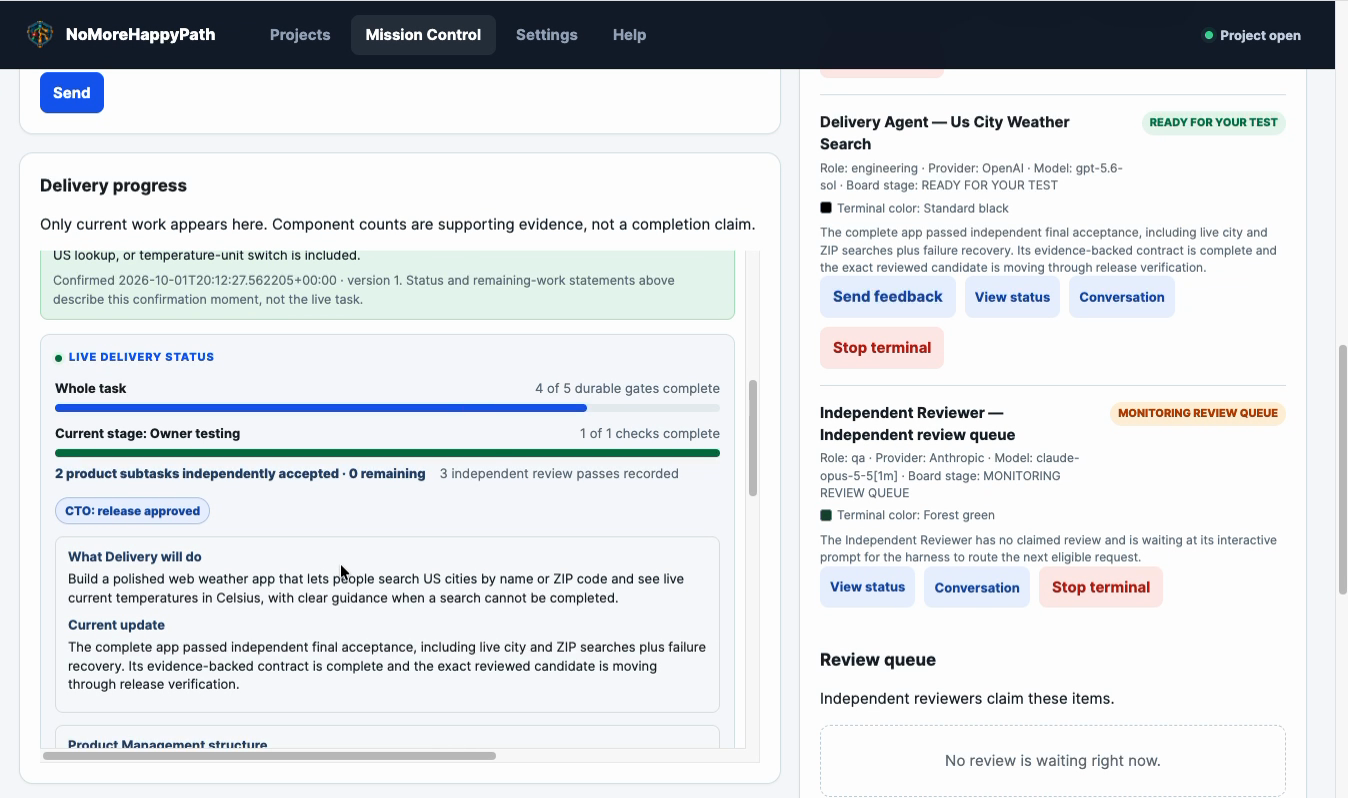
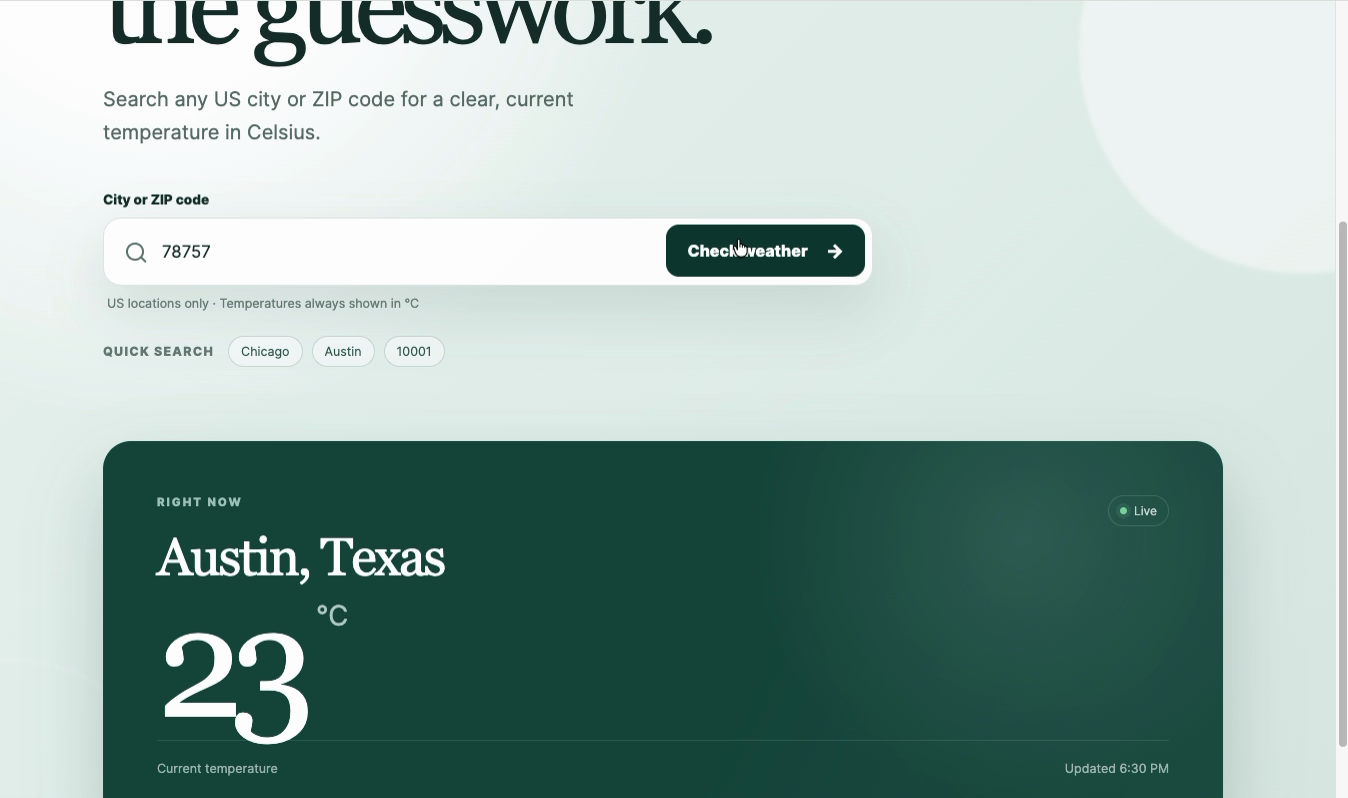
A real build, sped up: a weather app from one plain-English request. 48 minutes, 4 independent reviews, 1 failed. Narration by AI.
AI is great at the happy path. Customers don’t live there.
AI will build you an app that works in the demo. Then you find out what it didn’t test: the failed login, the empty screen, the error message that shows a stack trace. An AI that grades its own work passes itself almost every time, so you become the QA department for your own AI.
NoMoreHappyPath is built so that doesn’t happen: the work is checked by someone with no reason to agree.
From a sentence to software you can hand to a customer
You say what you want
In plain language. No code, no technical decisions.
It proposes the contract
Agents propose the requirements in plain language. You press Go ahead, or change them.
A team builds and checks
A builder builds. An independent reviewer from another company runs the work and can fail it. A CTO watches the whole process.
You test and accept
You get “ready for your test” with a checklist you can follow. “Done” stays your word.
A complete delivery system, not a prompt
Everything needed to take an idea to accepted, release-ready software runs on your own machine.
A team of agents
A builder, an independent reviewer from a different AI company, and a CTO that watches the process and tells you the one thing that needs you. Claude, Codex or Gemini can take any role.
A contract before any code
The agents propose the requirements for your approval, then plan the work and an evidence contract before anything is built.
A board agents can’t directly edit
Tasks, contracts and reviews are written only by the platform’s own software. A task advances only with evidence: tests run, failure paths tried, the whole app walked in a real browser.
Security by default
Agents are required to build in secrets handling, input checks, safe logins and error handling, and the reviewer checks them where they apply. An optional Enhanced security mode adds a threat model, security tests and a controls register.
A sandbox around every agent
The operating system confines every agent: it can write only to the project, its own CLI state, caches and temporary folders, not to your other files.
Self-healing
A stalled agent session is restarted for you (up to three times an hour), sign-in problems are flagged in plain words, and agents resume their saved conversation after a pause.
Mission Control
A local web app to watch every project, preview the app, ask questions about your project (project chat uses your own OpenAI API key), and accept the result.
Runs where you work
macOS, and headless Linux servers. The harness runs on your machine and your agents use your own accounts. There is no server of ours in the loop.
Open source
Apache 2.0. Every line is readable, free to use, and free to build on, commercially too. Over 2,000 automated tests.
Never tied to one vendor’s price
Your builder, your reviewer and your project watcher can each be Codex, Claude or Gemini. Swap them when prices or quality change. One rule never changes: whoever checks the work is never the same company as whoever built it.
Use a top model to write the plan, then lighter models to build and review: the process keeps the quality up, and your subscription usage down.
It checks what you forgot to ask for
Most AI-built apps ship without the things that quietly sink real products, because nobody thought to ask. The harness knows what a real product needs, and does it without being asked.
Security
Secrets kept out of the code, user input treated as plain text, passwords stored safely, repeated guesses slowed down, no internal errors shown to users, libraries checked for known problems.
A product people can use
Screens that work on phone and desktop, with keyboard and mouse, with empty, loading and error states handled. Not just “it rendered”.
Proof, not promises
The reviewer opens your app in a real browser and walks the path you asked for, then states plainly: task done, yes or no.
Professional-grade basics by default. Not a penetration test or a compliance audit.
A small app in 48 minutes, not 5. On purpose.
Any AI can produce a demo in five minutes. NoMoreHappyPath treats every project as a product to release to real customers, not an alpha or a beta. That standard is where the time goes.
5 minutes: a demo
- Built straight from the prompt
- Tested only where everything goes right
- The same AI says it works
- You find the problems after launch
48 minutes: a release
- Requirements written down and agreed before any code
- Built in parts, each part reviewed by a different AI
- Failure cases tried: a city that doesn’t exist, a service that is down
- Security and quality basics checked without being asked
- A failed review sent back, fixed, and checked again
- A final review that opens the whole app in a real browser
In the weather build on this page, one of the four reviews failed. A wrong “Updated” time. A five-minute demo would have shipped it. Here, it was caught, fixed and checked again before the app reached the owner.
Speed is cheap. Trust takes time. If you only need a demo, any AI will do. This is for when you intend to put the software in front of customers.
A commercial property-analysis product, from a business question
Not a demo app. PropDesk answers one question a land buyer actually has: what do I need to know before I spend serious time or money on this site? NoMoreHappyPath planned it, built it, integrated the public data, and had it checked by a different AI.
PropDesk, built with NoMoreHappyPath: parcel, utilities, flood, zoning, traffic and more in one workspace. Narration by AI.
It fails its own work, and says so
These come from the project’s own records, not mocks. Passing tests didn’t stop the reviewer from failing the work.
“…the advertised safe update path fail[s] after they follow the product’s own instruction.”
That is what it costs to build something you can trust.
What you need, honestly
The platform is free. The AI agents it runs are not: they use your own accounts, and a serious build costs real money on them.
| You need | Why | Cost |
|---|---|---|
| macOS 13+ or Linux | Tested on Ubuntu 24.04. Python 3.9+. Windows isn’t supported. | Free |
| Two AI companies’ CLIs | Any two of Codex, Claude Code and Gemini (Antigravity CLI), so the reviewer is never the builder’s vendor. | Your own plans |
| OpenAI API key | Your own key, only for asking questions about your project. | Pay per use |
Two commands
git clone https://github.com/nomorehappypath/nomorehappypath.git
cd nomorehappypath && bash install.sh
The installer checks everything above and tells you plainly what’s missing. Then open Mission Control, point it at a project folder, and give your first direction. Everything runs on your machine, and your code never goes to our servers.
What people ask first
Isn’t AI reviewing AI just theatre?
The reviewer isn’t reading a diff and nodding. It writes its own tests, the harness runs them and keeps the output, and the verdict has to match that output. A pass with no recorded execution behind it is refused. It also has no reason to agree: it comes from a different company than the builder.
Is this a code-review tool?
No. It’s a complete delivery system: you give it an idea and a team of agents plans, builds, tests and reviews it inside a governed board, with a local control room to run it. The independent review is one of the safeguards that makes the result trustworthy, not the product itself.
What does it cost to run?
The software is free. The agents run on your own subscriptions. A serious build uses real usage. Using a top model for the plan and lighter models for building and review keeps that down.
Why does even a small app take so long?
Because the harness builds for release, not for a demo. It agrees the requirements first, has a different AI review each part, tries the failure cases, checks security and quality basics, and finishes with a review that uses the whole app in a real browser. A weather app took 48 minutes and four reviews, and one of them failed. A demo takes five minutes and skips all of that.
Does my code leave my computer?
The harness runs on your machine and doesn’t send your code to us. Your agents talk to their own providers, the same as when you use those tools directly.
Is it really open source?
Yes. Apache 2.0: use it, change it, use it commercially.
Does it guarantee bug-free software?
No, and nothing does. It guarantees that what ships was checked by a different AI, with evidence you can read.